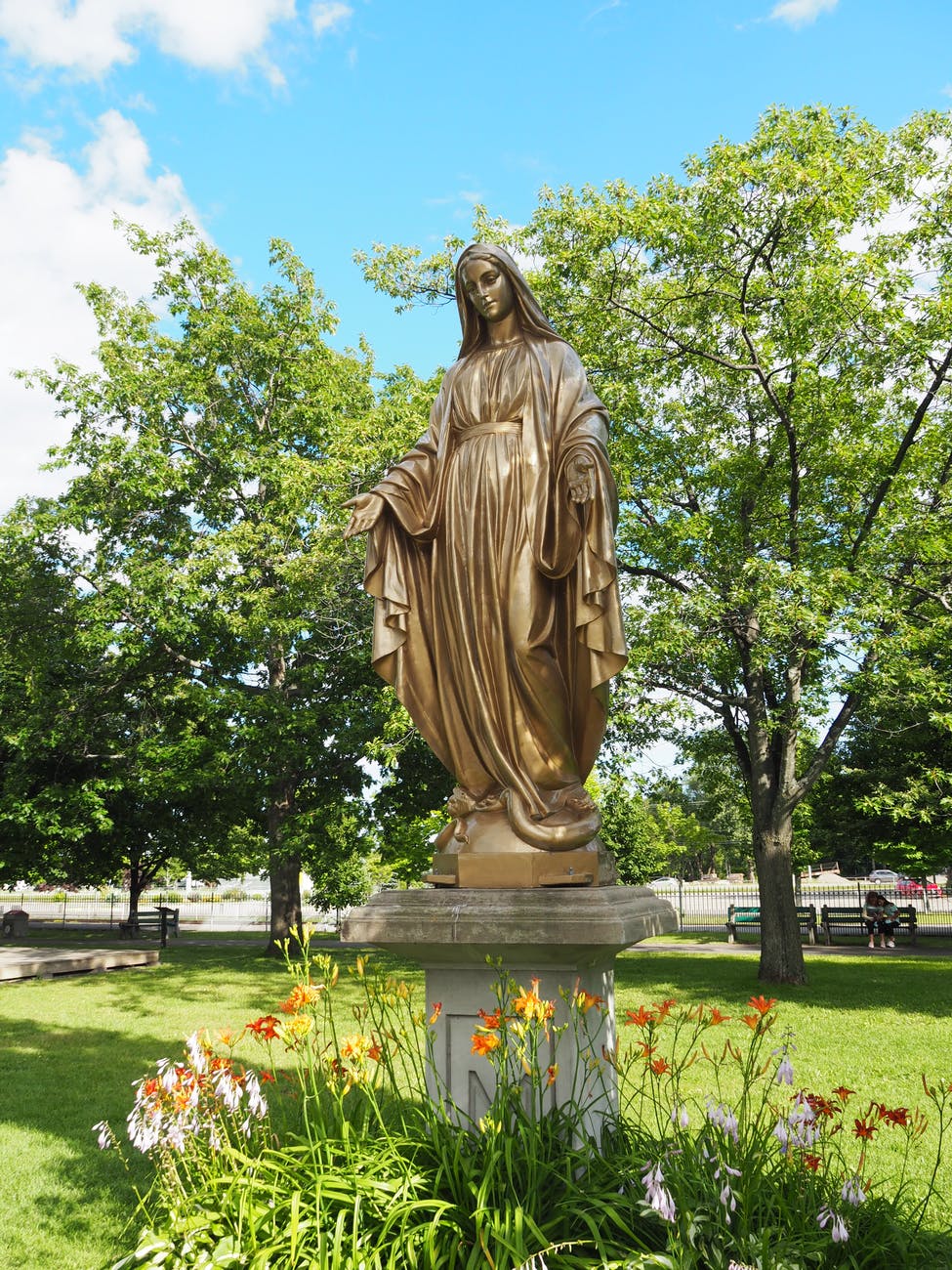
It just may be the most-often recited prayer of all Christian prayers–the “Hail Mary.”
In Latin it is called “Ave Maria.”
I know that personally I have prayed this prayer more than any other, mostly because it is the primary component of the Rosary. And also because when I was a little girl we went to confession often and the “Hail Mary” was the prayer assigned as penance.
During the three most critical moments in my life, I called upon Mary through this prayer for help and healing. When my husband and I were told that our younger son, at six months old, would need a serious surgery I prayed relentlessly for healing. And as each of my parents neared the hour of their death, I prayed for help for a peaceful passing.
Hail Mary, full of grace, the Lord is with thee.
Blessed art thou among women, and blessed is the fruit of thy womb, Jesus.
Holy Mary, Mother of God, pray for us sinners now, and at the hour of our death.
As a child, the prayer seemed longer. Only recently did I realize that it consists of just three sentences. And I’ve learned it is a two-part prayer (or a three-part prayer, depending on what source you refer to) to Our Lady that has evolved over many centuries.
The first part of the “Hail Mary,” the salutation or greeting, is rooted in scripture and quotes the archangel Gabriel, as well as St. Elizabeth.
Gabriel, according to Luke 1:26-38, says to Mary: “Hail, full of grace, the Lord is with you.”
Following that are words of praise from St. Elizabeth, whom Mary visited after the Annunciation. Referred to as The Visitation, it is recorded that when Elizabeth welcomed Mary after her journey, she said that the baby in her own womb (St. John the Baptist) leapt for joy upon hearing Mary’s voice. Elizabeth said to Mary: “Blessed are you among women, and blessed is the fruit of your womb!” (Luke 1:42)
We recite scripture every time we say the first part of the “Hail Mary!”
According to aleteia.com, for hundreds of years the second line in the first part of the prayer, concluding with “…blessed is the fruit of thy womb, Jesus,” was the end of the prayer. The words to the second part of the “Hail Mary” are not from scripture and were added during the 11th century. The site attributes the timing of the addition to the Catholic Encyclopedia which says: “…in point of fact, there is little or no trace of the “Hail Mary” as an accepted devotional formula before about 1050.”
The second part of the prayer consists of supplication. It is where we bring our requests to Mary with a statement asking her to intercede on our behalf “…now and at the hour of our death.” Bishop Fulton Sheen called these times “the two decisive moments of life” in his book “The World’s First Love.”
Records show that asking for Mary’s intercession through the “Hail Mary” devotional during the “Black Death” (the bubonic plague pandemic that occurred during the mid-1300s), and adding the supplication asking Mary to “pray for us now and at the hour of our death,” helped bond the two parts of the prayer together into one.
Some 200 years later, the complete prayer was first included in the Roman Breviary in 1568.
Interesting aside… Here’s the story of how the “Hail Mary” pass came to be.
I am hoping to bring more knowledge about the Virgin Mary to the world, especially during these times when we need her most. Please consider sharing this post, this site, or its social media pages on Facebook and Instagram. I invite you to subscribe to this site (below) to be notified of new posts. Thank you.
 searchingforthevirginmary.com