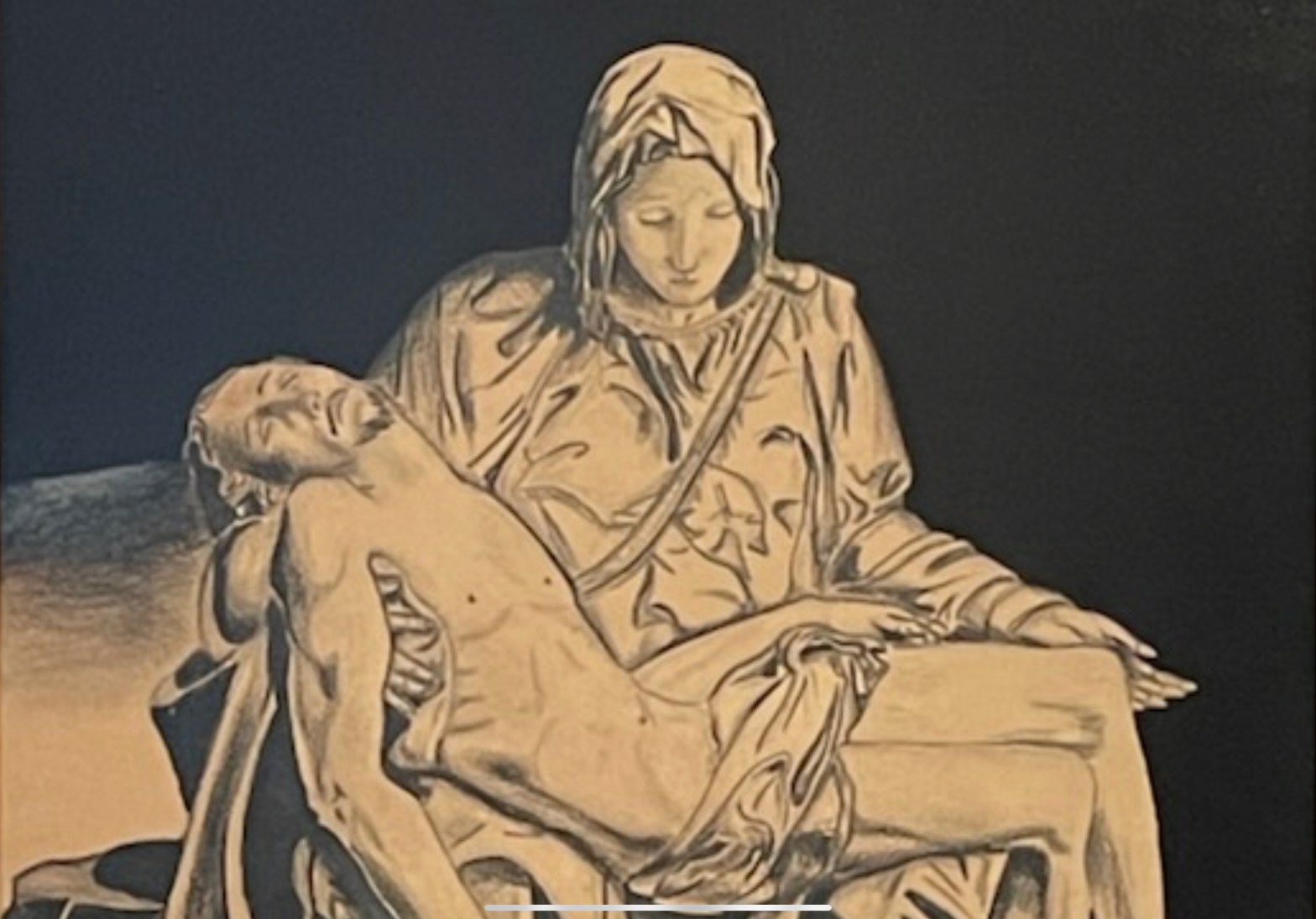
This image of Michelangelo’s Pieta, painted by my older brother, has hung on the dining room wall in our parents’ home for several decades. All of our extended family gatherings included a meal at the table in that room, often with three generations present. (At a later point, my brother painted Moses as a gift to my father and it was hung on the wall opposite his Pieta.)
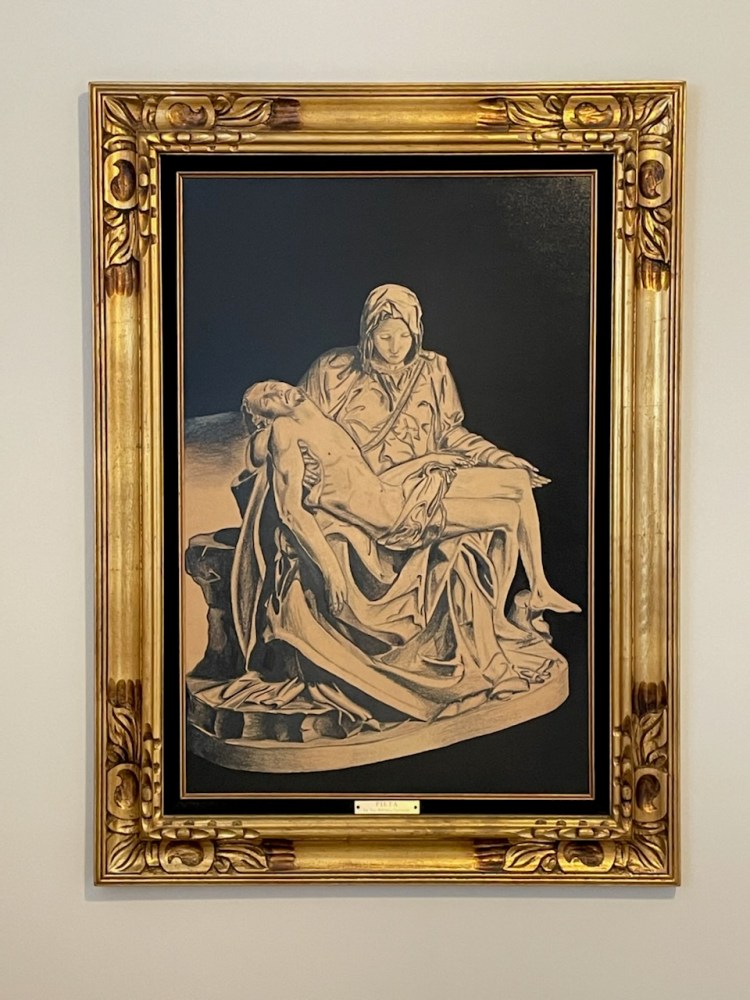
What I never appreciated, while passing the mashed potatoes and helping our mother serve the birthday cake, was the suffering Mary endured two millennial ago that was depicted in the painting. It wasn’t until recently, as I started this journey to learn more about the Virgin Mary’s earthly life, that I realized that the moment captured by the sculpture of the Pieta, and in my brother’s artwork, was the sixth of Mary’s Seven Sorrows; the time at which Jesus’ body was taken down from the cross and placed in his mother’s arms. Note: This moment is also the 13th station in the Stations of the Cross.
The most interesting and easy-to-understand information I found on this sixth “sorrow” of the Virgin Mary was found here: ourcatholicprayers.com. With permission from Christopher Castagnoli, a lay volunteer at St. Patrick’s Cathedral in New York City, who in 2006 established the website, I have paraphrased what is posted there about this particular “sorrow.” The below also includes references from various other online sources.
St. Bridget of Sweden, a mystic, at an early age had visions of Christ in which he shared his passion and death. She also received a devotion from the Blessed Mother herself, related to her Seven Sorrows. Mary promised graces to those who reflect on her “sorrows” daily. I have since incorporated this into my daily prayers.
From ourcatholicprayers.com:
Mary revealed to St. Bridget of Sweden some extraordinarily painful details in one of many private revelations which have been approved by the church as having nothing in them contrary to faith and morals.
She told her that, “A man [the soldier, commonly known to us today as Longinus] came up and drove a spear so forcefully into His [Jesus’] side that it almost came out of the other side. And as soon as he drew it out, its point was all red with blood. The Heart of my beloved Son was so violently and mercilessly pierced that the spear split His heart in two. When I saw that my Son’s Heart had been stabbed through, I felt that my own heart was likewise pierced, and it was a wonder that it did not break.”
Mary continued to share the experience with St. Bridget of Sweden:
“While the others left the scene, I did not want to go away. Later my Son was taken down from the Cross…. we carried Him to a stone which I had covered with clean linens. All my Son’s limbs had become stiff and cold in death, and the blood which had flowed over them during His Passion adhered to them. But I was indeed consoled that I could touch His body and take him onto my lap, examine His wounds and dry up the blood…. Then they laid Him out on some clean linen, and with my cloth, I washed His wounds and His limbs. And with my fingers I closed His eyes and His mouth, which were open when he died.”
I am hoping to bring more knowledge about the Virgin Mary to the world, especially during these times when we need her most. Please consider sharing this post, this site, or its social media pages on Facebook and Instagram. I invite you to subscribe to this site (below) to be notified of new posts. Thank you.
 searchingforthevirginmary.com
2 thoughts on “The sixth “sorrow” of Mary”