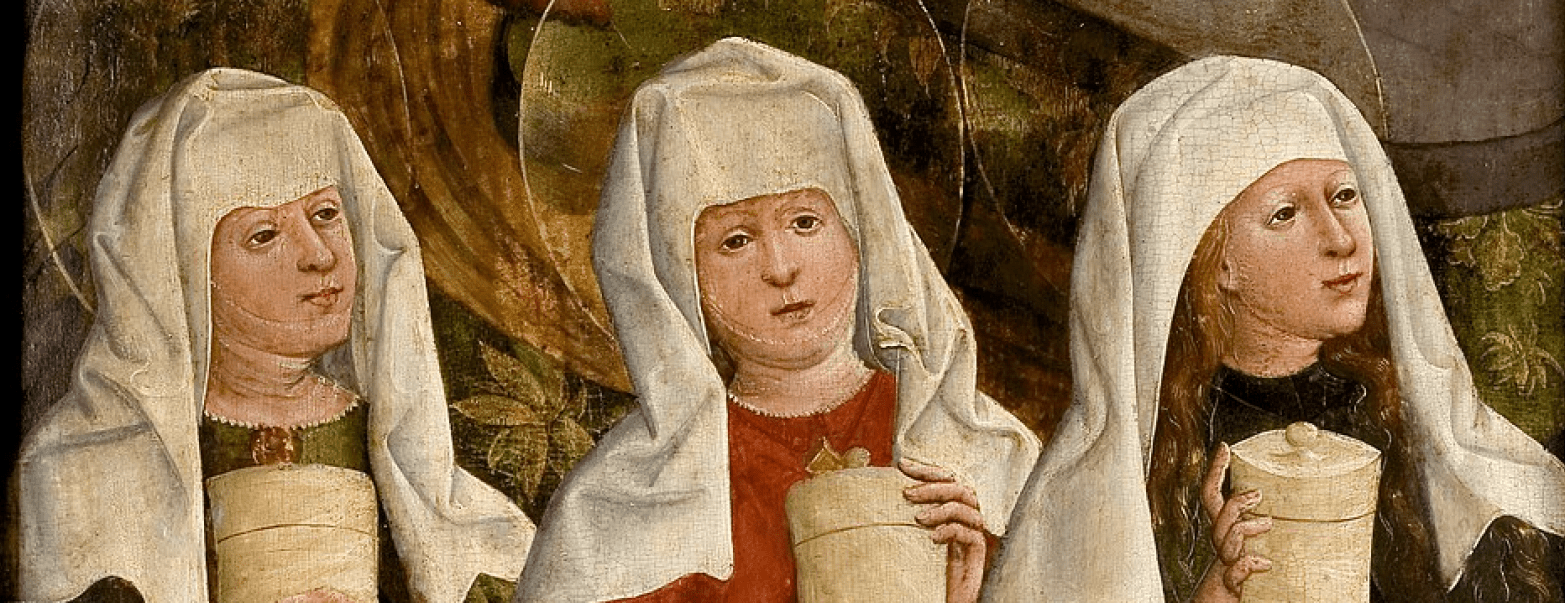
Who is “the other Mary?”
Every Easter season the scripture readings about Christ’s resurrection reference “the other Mary,” the woman who was at the tomb with Mary Magdalene when they discovered that the body of Jesus was no longer there. But, who was “the other Mary?”
Mary Magdalene and the other Mary were sitting there opposite the tomb.
– Matthew27:61
After the Sabbath, at dawn on the first day of the week, Mary Magdalene and the other Mary went to look at the tomb.
– Matthew 28

Orjen, CC BY-SA 3.0 https://creativecommons.org/licenses/by-sa/3.0, via Wikimedia Common
I often wonder who this unsung woman was. She, along with Mary Magdalene, were witness to the most important event in the history of humanity. Why wasn’t she named?
In researching this, I became very confused. And for good reason.
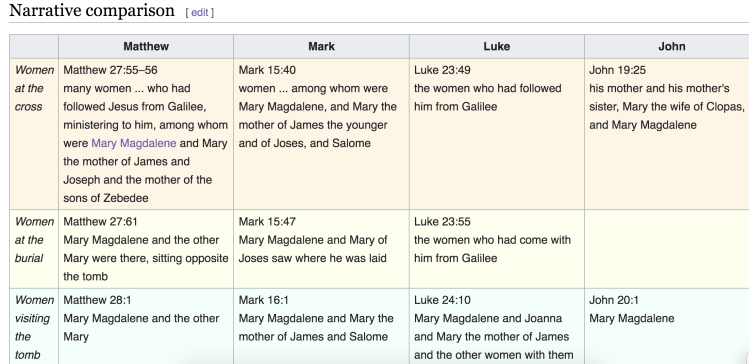
Multiple women named Mary were present at three significant venues: the women at the foot of the cross, those women who attended the burial, and the women who discovered the empty tomb.
To further complicate things, the women at each venue were noted in the gospels of four different apostles (Matthew, Mark, Luke and John), three of which were written some 65 to 85 years after Christ’s death and resurrection. John’s writings were as late as 95 years after the resurrection.
On the website livingwithfaith.org, it is explained that the name Mary was a very common name at the time of Christ. Women were often described by their first name and then some other affiliation, such as to whom they were married or the town in which they resided. Sometimes they were referred to as “the mother of…”
First, let’s start with Mary, the Mother of God. Prior to the world discovering that the young virgin was indeed the Mother of God, what was her last name? Mary would likely have been referred to as “Mary of Nazareth,” or “Mary, daughter of Joachim.” After marrying Joseph, she could have been called “Mary, wife of Joseph.”
Wikipedia’s reference to Mary Magdalene, the second most-recognized Mary named in the Bible, says that her “last name” is in reference to the town from which she came: Magdala. She was the first person to whom Jesus appeared after rising from the dead.
And then we have Mary, the wife of Clopas. According to Smithsonian Magazine, she is also referred to in the Bible as “Mary, the mother of James and Joseph.” She is also said to be the sister of the Blessed Mother and, therefore, the aunt of Jesus. However, Aleteia.com suggests that she may have been Mary’s (the Mother of God) sister-in-law.
Another Mary, Mary of Bethany, is also mentioned in Luke’s Gospel, 7:36-50. Mary of Bethany appears in the text as the sister of Martha and Lazarus. She is known as the woman who anointed the feet of Jesus with expensive oils.
The Los Angeles Times article “The elusive ‘other Mary,’” written by Reed Johnson, speaks to the confusion over which of the women named Mary were actually at which events. Even Pope St. Gregory I (c. 540-604), who claimed “the other Mary” who was with Mary Magdalene at the empty tomb was, in fact, Mary of Bethany, couldn’t succeed at putting the question to rest. His claim of Mary of Bethany has continued to be challenged by religious scholars.
If I am worthy of entrance into God’s Kingdom I would like to talk to, in this order, the following: God Almighty, Jesus Christ, Mary (the Mother of God), my own parents… and then… the “other Mary.” I would like to hear her story.
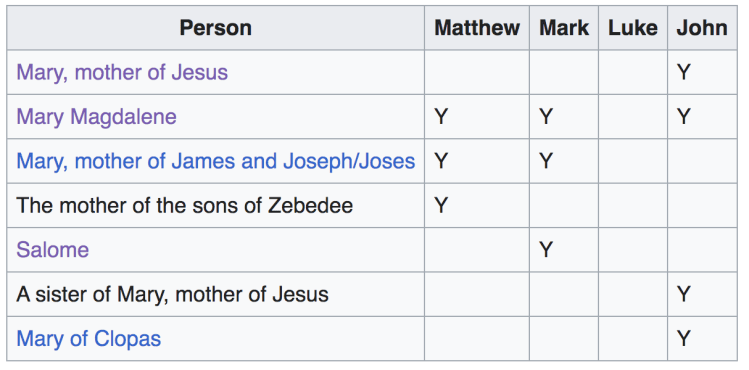
In the meantime, here are charts from Wikipedia that will serve to either confuse or to clarify your own understanding of the mystery of “the other Mary.”
WOMEN AT THE CROSS, THE BURIAL, AND THE TOMB
FOUR GOSPELS THAT PLACE SPECIFIC WOMEN AT THE CRUCIFIXION
I am hoping to bring more knowledge about the Virgin Mary to the world, especially during these times when we need her most. Please consider sharing this post, this site, or its social media pages on Facebook and Instagram. I invite you to subscribe to this site (below) to be notified of new posts. Thank you.
 searchingforthevirginmary.com