
For a woman who changed the course of humanity when she agreed to bear the son of God, the Virgin Mary was surprisingly quiet about everything.
Contrast that with today’s social-media-driven culture that is all about selfies and influencers, and the contrast is amplified. My guess is that even if Mary had today’s tech tools available to her back then, she wouldn’t have needed them. She’d still be known for all of eternity for her humility, faith and mercy. And, of course, her role as the mother of Jesus.
References to her in the Catholic Bible’s gospels of Matthew and Luke total 19 to 20 times. (The differences depend on which version of the Bible you’re reading — the Revised New American Bible (RNAB), or the Revised Standard Version Catholic Edition (RSVCE).
A search for “Mary” in either Bible will yield all the Marys that were present at various times and events (i.e., Mary Magdalene; Mary, the wife of Cleophas [or Clopas]; Mary of Bethany; Mary, the mother of James, etc.). It sure was a popular name at the time. In fact, nearly one in four women were named Mary during this period.
Despite the significance of her role in our salvation, the Virgin Mary’s own words appear only four times: The Annunciation (Luke 1:34 and 38), The Wedding Feast at Cana (John 2:3 and 5), The Finding in the Temple (Luke 2:48), and in The Magnificat, as she embraces her role in the salvation of humanity (Luke 1:46-55). Her quotes are very succinct, with the exception of the Magnificat.
Note: Aside from Jesus, the most-mentioned names in the Bible are David, Moses and Jacob, according to the RNAB.
So why is there so little about Our Lady in the Bible?
One theory is that the gospels, written by Matthew, Luke, Mark and John, were focused on the life, death and resurrection of Jesus. They were not written with Mary as the focal point. Their purpose was not to tell the life story of the mother of Jesus, but rather to note her role as the mother of God. (I’m thinking that if the authors of the gospels lived long enough to learn of Mary’s apparitions, they might have expanded their writings to include more details about her life.)
Another possibility for the minimal attention to Our Lady in the Bible may have been the desire not to promote the worship of Mary. You’ve likely heard, “To Jesus, through Mary.” That was clearly the mission of the writers of the gospels; to focus on Jesus and the path to him.
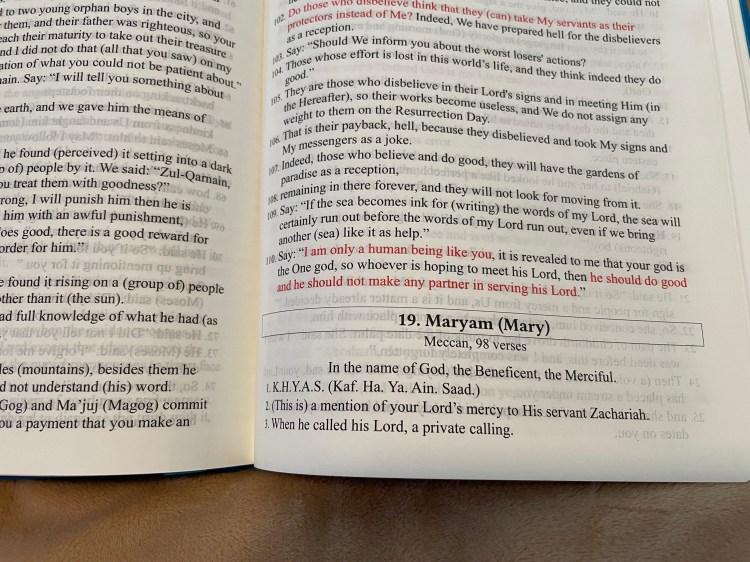
Note: Mary is mentioned more than 30 times in the Quran (See image above). Chapter 19, titled “Maryam,” details the events of the Annunciation, the Nativity of our Lord, and much more. In “A Simple and Concise Translation of the Quran,” a project that the author says took 21 years to complete, the account of the Annunciation and the Nativity are much the same as what appears in the Catholic Bibles, albeit with different dialogue.
In “The strength of Mary’s silence” Dr. Tod Worner discusses Mary’s “quiet strength” and asks the question: “But what if Mary saw through the suffering? What if, at her worst moment, Mary believed (as remote as they may seem) her God’s promises?”
Worner’s beautiful description of Michelangelo’s Pieta speaks to both her sorrow and her faith. It is worth the read.

